A good bookkeeper keeps your records accurate and current. That job matters, and plenty of businesses never need more than that.
But at some point the business starts asking questions the books can’t answer. Can we afford a second crew? Why did we have a record quarter and still scramble to make payroll? Which jobs actually made money?
Those are controller questions. Most owners run into them years before a full-time controller makes financial sense. That gap is where reporting slips, cash gets tight without warning, and decisions get made on instinct.
Here are six signs you’re in it.
1. Your books close late, or not at all
If it’s May and March still isn’t reconciled, your financial statements are history by the time you see them. You can’t correct a margin problem you find out about three months later.
A bookkeeper records transactions. A controller runs the close: a set calendar, reconciled accounts, accruals booked, and statements you can trust within a couple of weeks of month-end.
2. You’re making big decisions without numbers to back it up
Hiring, buying equipment, raising prices, signing a lease on a second location. If these decisions come down to your gut and your bank balance, you’re missing a step.
Your bookkeeper can tell you what happened last month. A controller can tell you what happens to cash, margin, and debt coverage if you make the move, and what happens if you wait six months.
3. You’re profitable on paper, but short on cash
This is the most common one we see. The P&L says you made money, but the account is thin every other Friday.
Cash usually hides in receivables, inventory, retainage, loan principal, or a tax bill nobody planned for. A controller builds a cash flow forecast, often looking 13 weeks out, so you see the crunch coming instead of reacting to it.
4. You can’t tell which jobs, products, or customers make money
Total revenue is up. Total profit is flat. Something is losing money, and you don’t know what.
For contractors around Mansfield and Arlington, this usually means job costing isn’t set up by project and phase, change orders aren’t tracked cleanly, and there’s no WIP schedule. For manufacturers and distributors, it’s margin by product line or customer. Either way, you need reporting built around how your business actually earns money, not just a chart of accounts.
5. A lender, bonding company, or investor wants more than you can give
Cash-basis statements and a tax return worked when you were small. Now the bank wants accrual financials, covenant calculations, or reviewed statements. Your surety wants a WIP schedule and a clean balance sheet before they’ll raise your bonding limit.
If pulling these together takes weeks, or the numbers change every time someone asks, that’s costing you capacity and credibility.
6. Nobody is checking the checker
In a lot of small businesses, one person enters bills, pays them, and reconciles the bank account. That’s efficient, and it’s also how errors and fraud go unnoticed for years.
A controller puts basic internal controls in place: approval limits, separated duties, and reviews that catch problems early. It’s not about distrusting your bookkeeper. It’s about not relying on any one person being perfect.
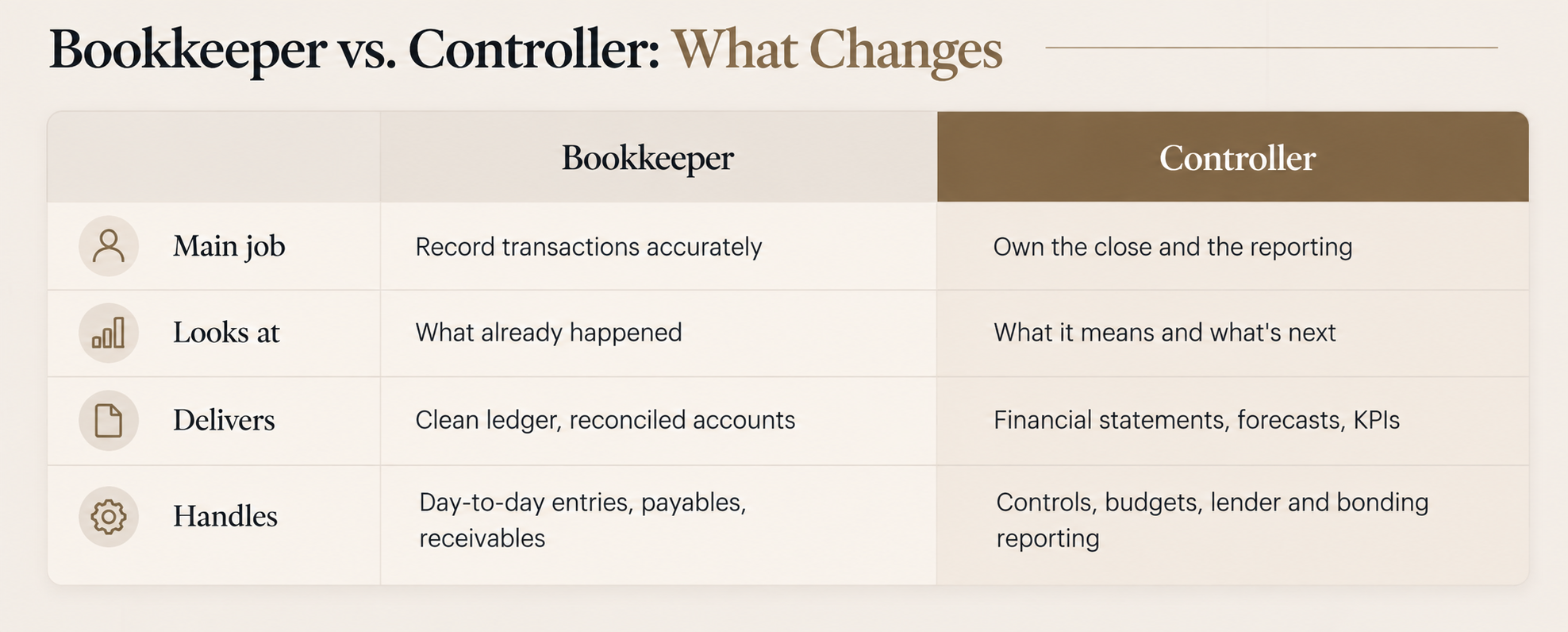
You don’t replace your bookkeeper when you bring in a controller. The controller sits above that work, reviews it, and turns it into something you can use.
When to hire a controller, and when to wait
If you checked off two or three of the signs above, it’s time to look at controller-level help.
That doesn’t mean a full-time hire. A full-time controller in Dallas-Fort Worth is a six-figure salary before benefits, and most businesses under a certain size don’t have enough work to fill that seat.
A fractional controller works a set number of days per month. You get the close, the reporting, the forecasting, and the controls without the full-time cost. As you grow, the hours grow with you, and eventually the numbers will show when a full-time hire makes sense.
If you only checked one sign, or none, you may not need a controller yet. Better bookkeeping processes might be enough. That’s worth knowing too.
How FFG Advisory helps
Abbey Fajimolu spent 20 years in accounting, working from Staff Accountant to Controller across construction, oil and gas, manufacturing, and nonprofits. She founded FFG Advisory in Mansfield to bring that same controller-level work to businesses in Mansfield, Arlington, and across North Texas that aren’t ready to hire it full-time.
Book a free 30-minute call. Bring your questions about the business, and Abbey will tell you straight whether you’ve outgrown your bookkeeper or not.